

Torque is a fundamental concept when it comes to understanding the capabilities and applications of brushed DC geared motors. As a supplier of these motors, I've had the privilege of working closely with various industries and customers, witnessing firsthand how torque impacts the performance of these motors in different scenarios. In this blog, I'll delve into what torque is, how it relates to brushed DC geared motors, and why it matters in real - world applications.

What is Torque?
Torque, in simple terms, is a measure of the rotational force that a motor can generate. It is what causes an object to rotate around an axis. Mathematically, torque ((\tau)) is calculated as the product of the force ((F)) applied perpendicular to the radius ((r)) from the axis of rotation, i.e., (\tau = F\times r). In the context of a motor, torque determines how effectively the motor can start, stop, and maintain the rotation of a load.
The unit of torque is typically Newton - meters (N·m) in the SI system, or foot - pounds (ft - lb) in the imperial system. For smaller motors, like the ones we supply as brushed DC geared motors, millinewton - meters (mN·m) are often used.
Torque in Brushed DC Geared Motors
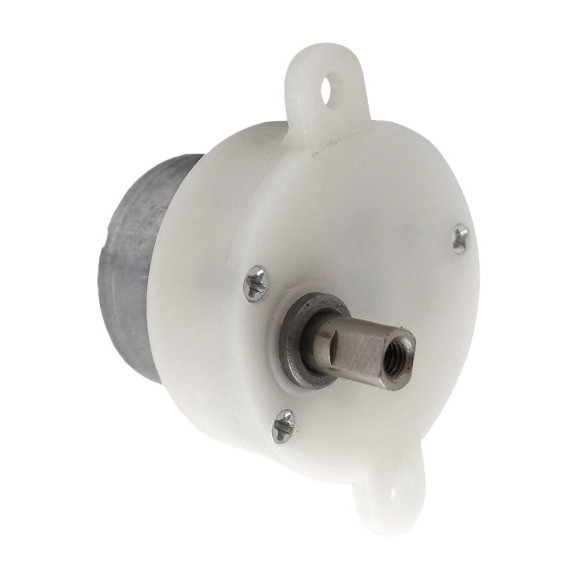
Brushed DC motors are a type of electric motor that uses brushes and a commutator to convert electrical energy into mechanical energy. The addition of a gearbox to a brushed DC motor creates a brushed DC geared motor. The gearbox serves several purposes, one of the most important being to modify the torque and speed characteristics of the motor.
When power is applied to a brushed DC motor, an electromagnetic field is created, which interacts with the permanent magnets in the motor to produce a rotational force. However, the raw torque output of a brushed DC motor may not be sufficient for many applications. This is where the gearbox comes in.
A gearbox is a set of gears that can change the speed and torque of the motor. By using gears of different sizes, the gearbox can either increase the torque at the expense of speed or increase the speed at the expense of torque. In most cases, the gearbox in a brushed DC geared motor is designed to increase the torque.
The gear ratio of a gearbox is a crucial factor in determining the torque output of a brushed DC geared motor. The gear ratio is defined as the ratio of the number of teeth on the driven gear to the number of teeth on the driving gear. For example, if a gearbox has a gear ratio of 10:1, it means that for every 10 rotations of the motor shaft, the output shaft of the gearbox will make 1 rotation. This reduction in speed results in an increase in torque. The output torque ((\tau_{out})) of a brushed DC geared motor can be calculated using the following formula:
(\tau_{out}=\tau_{in}\times GR\times\eta)
where (\tau_{in}) is the input torque from the motor, (GR) is the gear ratio, and (\eta) is the efficiency of the gearbox. The efficiency takes into account the losses that occur in the gearbox due to friction, heat, and other factors.
Factors Affecting Torque in Brushed DC Geared Motors
Several factors can affect the torque output of a brushed DC geared motor.
Motor Design
The design of the brushed DC motor itself plays a significant role in determining its torque output. The number of turns in the motor's coils, the strength of the permanent magnets, and the size of the motor all influence the amount of torque the motor can produce. Motors with more turns in the coils or stronger magnets generally have higher torque outputs.
Supply Voltage
The supply voltage to the motor also affects the torque. As the voltage increases, the current flowing through the motor's coils also increases, which in turn increases the magnetic field strength. This results in a higher torque output. However, it's important to note that increasing the voltage beyond the motor's rated voltage can damage the motor.
Load Characteristics
The type of load that the motor is driving can also impact the torque requirements. For example, a load that requires a high starting torque, such as a conveyor belt or a winch, will need a motor with a higher torque output. On the other hand, a load that requires a constant speed, such as a fan, may not need as much torque.
Gearbox Efficiency
As mentioned earlier, the efficiency of the gearbox affects the output torque of the motor. A more efficient gearbox will transfer more of the motor's input torque to the output shaft, resulting in a higher output torque. Factors such as the quality of the gears, the lubrication, and the design of the gearbox all influence its efficiency.
Importance of Torque in Applications
Understanding the torque requirements of an application is crucial for selecting the right brushed DC geared motor. Here are some common applications and how torque plays a role in them.
Robotics
In robotics, brushed DC geared motors are often used to power the joints and actuators. The torque output of the motor determines how much weight the robot can lift or how much force it can apply. For example, a robotic arm that needs to pick up heavy objects will require a motor with a high torque output.
Automotive
In the automotive industry, brushed DC geared motors are used in various applications, such as power windows, windshield wipers, and seat adjusters. The torque of the motor determines how quickly and smoothly these functions can operate. A motor with insufficient torque may cause the window to move slowly or the seat adjuster to get stuck.
Industrial Automation
In industrial automation, brushed DC geared motors are used to drive conveyor belts, pumps, and other equipment. The torque requirements of these applications depend on the size and weight of the load. A conveyor belt that needs to move heavy products will require a motor with a high torque output to ensure smooth and efficient operation.
Our Product Range
As a supplier of brushed DC geared motors, we offer a wide range of products to meet different torque requirements. Our Dc Brush Gear Motor series is designed to provide reliable and efficient performance. We also have a selection of Brushed Dc Geared Motor 12v for applications that require a specific voltage. For applications that need low - speed and high - torque operation, our Low Rpm Dc Gear Motor is an ideal choice.
Contact Us for Procurement
If you're in the market for brushed DC geared motors and need to find the right motor for your application, we're here to help. Our team of experts can assist you in selecting the motor with the appropriate torque output and other specifications. We understand that every application is unique, and we're committed to providing customized solutions to meet your specific needs. Whether you're a small - scale manufacturer or a large industrial enterprise, we can offer you high - quality brushed DC geared motors at competitive prices. Don't hesitate to contact us for procurement discussions and let us help you find the perfect motor for your project.
References
- Chapman, S. J. (2012). Electric Machinery Fundamentals. McGraw - Hill.
- Fitzgerald, A. E., Kingsley, C., & Umans, S. D. (2003). Electric Machinery. McGraw - Hill.