

As a reputable provider of Lubrication Peristaltic Pump, understanding the technical specifications of our products is crucial. One of the frequently asked questions in the industry is about the minimum tubing inner diameter for a lubrication peristaltic pump. In this blog, we will explore the factors influencing this parameter, the significance of the minimum tubing inner diameter, and how it relates to the overall performance of the pump.
Factors Influencing the Minimum Tubing Inner Diameter
Viscosity of the Lubricant
The viscosity of the lubricant is one of the primary factors that determine the minimum tubing inner diameter. Lubricants with high viscosity flow less easily compared to those with low viscosity. For highly viscous lubricants, a larger tubing inner diameter is required to ensure smooth flow through the pump. If the tubing diameter is too small, the resistance to flow will be high, which can lead to reduced flow rates, increased energy consumption, and potential damage to the pump. On the other hand, for low - viscosity lubricants, a smaller tubing inner diameter can be used without significant flow restrictions.
Flow Rate Requirements
The desired flow rate of the lubrication system also plays a vital role in determining the minimum tubing inner diameter. If a high flow rate is required, a larger tubing inner diameter is necessary. This is because the flow rate is directly proportional to the cross - sectional area of the tubing. According to Poiseuille's law, the volumetric flow rate (Q) of a fluid through a cylindrical tube is given by the formula:
[Q=\frac{\pi r^{4}\Delta P}{8\eta L}]
where (r) is the radius of the tube, (\Delta P) is the pressure difference across the tube, (\eta) is the dynamic viscosity of the fluid, and (L) is the length of the tube. As we can see from the formula, the flow rate is highly sensitive to the radius of the tube (since it is raised to the fourth power). Therefore, if a high flow rate is needed, increasing the tubing inner diameter (and thus the radius) can significantly improve the flow rate.
Pressure Requirements
The pressure at which the lubricant needs to be delivered also impacts the minimum tubing inner diameter. Higher pressures require stronger tubing and, in some cases, a larger inner diameter to withstand the pressure without collapsing or bursting. If the tubing inner diameter is too small for the required pressure, the pump may not be able to generate enough pressure to overcome the resistance in the tubing, resulting in poor lubrication performance.
Significance of the Minimum Tubing Inner Diameter
Accuracy of Lubrication
The minimum tubing inner diameter affects the accuracy of the lubrication process. A properly sized tubing ensures that the correct amount of lubricant is delivered to the desired location. If the tubing inner diameter is too large, there may be an over - delivery of lubricant, which can lead to waste, contamination, and potential damage to the equipment. Conversely, if the tubing inner diameter is too small, the lubricant supply may be insufficient, leading to increased wear and tear on the moving parts.
Pulsation and Flow Stability
The tubing inner diameter also influences the pulsation and flow stability of the peristaltic pump. A smaller inner diameter can cause more significant pulsations in the flow, which may not be suitable for applications that require a continuous and stable flow of lubricant. On the other hand, a larger inner diameter can help to reduce pulsations and provide a more consistent flow.

Pump Life and Maintenance
The choice of tubing inner diameter can have a direct impact on the pump's life and maintenance requirements. Using a tubing with an inappropriate inner diameter can cause excessive wear on the pump components, such as the rotor and the tubing itself. This can lead to more frequent maintenance and replacement of parts, increasing the overall cost of ownership.
Products and Their Tubing Requirements
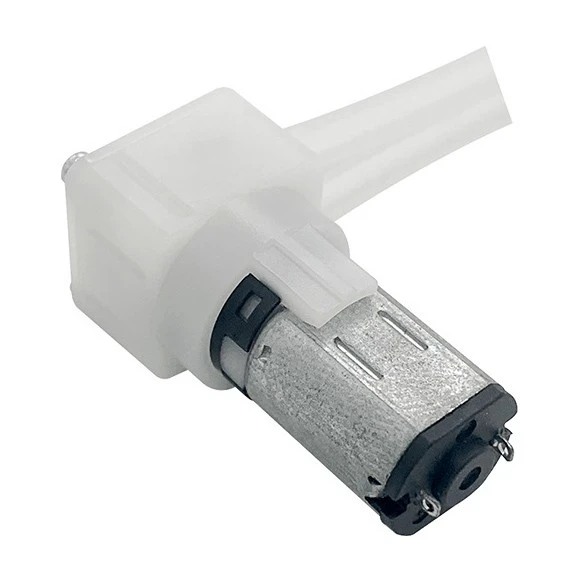
Mini Peristaltic Pump 12v
Our Mini Peristaltic Pump 12v is designed for applications where space and power consumption are critical. This pump is suitable for low - to medium - flow rate applications. For most common lubricants used in these types of applications, a minimum tubing inner diameter of approximately 0.5 mm to 1.5 mm can be used. However, if the lubricant has a relatively high viscosity or if a higher flow rate is required, a larger inner diameter may be necessary.
Compact Peristaltic Pump
The Compact Peristaltic Pump is a versatile solution that can handle a wide range of flow rates and lubricant viscosities. Depending on the specific application requirements, the minimum tubing inner diameter can vary from 1 mm to 3 mm. For high - viscosity lubricants or applications with high pressure requirements, a larger inner diameter within this range is recommended.
How to Determine the Optimal Minimum Tubing Inner Diameter
Consultation with Experts
If you are unsure about the minimum tubing inner diameter for your lubrication peristaltic pump, it is advisable to consult with our technical experts. We have a team of experienced engineers who can analyze your specific application requirements, including the type of lubricant, flow rate, and pressure, and recommend the most suitable tubing inner diameter.
Testing and Evaluation
In some cases, it may be necessary to conduct testing and evaluation to determine the optimal tubing inner diameter. This can involve using different tubing sizes in a test setup and measuring the flow rate, pressure, and other performance parameters. By comparing the results, you can select the tubing inner diameter that provides the best performance for your application.
Contact Us for Purchase and Consultation
If you are interested in our Lubrication Peristaltic Pump products or need more information about the minimum tubing inner diameter, please feel free to contact us. Our dedicated sales team is ready to assist you with your purchase and provide you with all the necessary technical support. We are committed to providing high - quality products and excellent customer service to meet your lubrication needs.
References
- Bird, R. B., Stewart, W. E., & Lightfoot, E. N. (2007). Transport Phenomena. John Wiley & Sons.
- Incropera, F. P., & DeWitt, D. P. (2001). Fundamentals of Heat and Mass Transfer. John Wiley & Sons.
- Bhattacharyya, D. (2011). Chemical Engineering Fluid Mechanics. CRC Press.