


Micro Solenoid Valve
Micro Solenoid Valves for Compact Air and Water Control
Pinmotor manufactures micro solenoid valves for controlling air and water inside compact equipment.
The product range includes small 2-way and 3-way valves for pneumatic and liquid systems, with different DC voltage and port configurations available across the series.
Our valves are used in medical devices, pneumatic equipment, analytical instruments, beverage machines, water dispensers and other OEM products where installation space is limited.


Small and Miniature Solenoid Valve Range
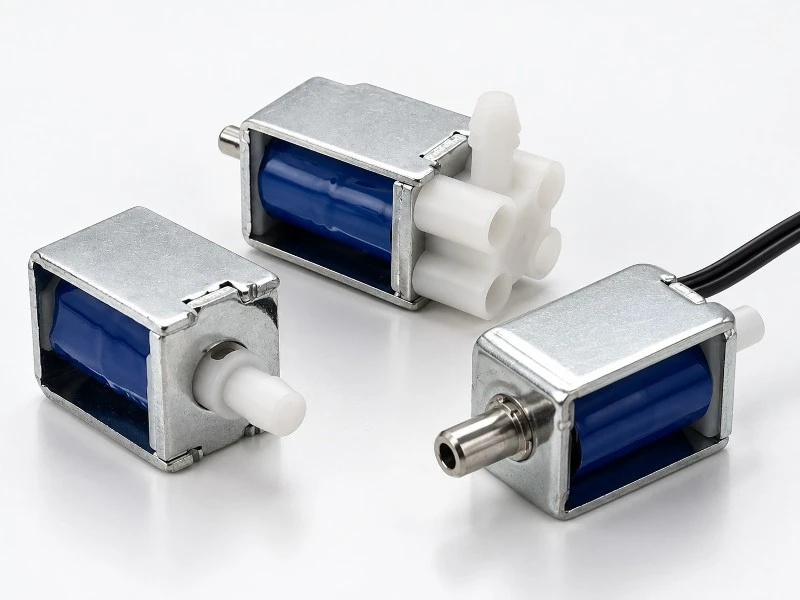
The terms micro solenoid valve, miniature solenoid valve and small solenoid valve are commonly used for compact electromagnetic valves installed inside equipment rather than in external industrial piping.
Pinmotor focuses on valve sizes suitable for integrated OEM products.
Small body dimensions make these valves easier to place beside pumps, tubing, sensors and control boards inside one enclosure.
For projects with very limited installation space, the valve body, port direction and wire outlet can be checked against the equipment drawing before a model is selected.
Valve Configurations
This section explains how Pinmotor valves are grouped by internal flow configuration.

2-Way Solenoid Valve
A 2-way valve has two main ports.
Its function is simple: open or stop one controlled flow path.
It is used where the circuit only requires one inlet and one outlet.

3-Way Solenoid Valve
A 3-way valve has an additional port.
The third port allows the valve to switch between different flow paths or combine inlet and exhaust functions within one component.

Normally Closed
A normally closed valve keeps its controlled path closed when the coil has no power.
Energizing the coil changes the valve state.
Normally Open
A normally open valve maintains its normal open or exhaust path without electrical power.
The valve changes state when voltage is applied.
Air and Water Solenoid Valve Categories
Pinmotor separates pneumatic and liquid valves because the internal flow path and sealing conditions are different.
Micro Solenoid Air Valve
Air-valve models are designed for pressure, vacuum, inflation, exhaust and pneumatic switching circuits.
They are commonly integrated with micro air pumps and vacuum pumps.
View the full pneumatic range here:
Mini Solenoid Water Valve
Water-valve models are designed for liquid opening, shut-off and path switching.
They are used in small water circuits where electrical control is required inside the equipment.
View the liquid-control range here:
Mini Solenoid Water Valve
How to Select a Micro Solenoid Valve
For a new project, provide the following information first.
|
Selection Item |
Information Required |
|
Medium |
Air or water |
|
Working condition |
Positive pressure or vacuum |
|
Valve function |
Open/close or path switching |
|
Power supply |
Required DC voltage |
|
Connection |
Port or tubing size |
|
Installation |
Available space and port direction |
|
Duty cycle |
Expected switching frequency |
Start With the Medium
Identify whether the valve will work with air or water. This determines which product family to check first.
01
Provide the Working Pressure
Give the normal operating pressure or vacuum level used in the equipment.
Normal working data is more useful for model selection than an isolated maximum value.
02
Define the Valve Function
State whether the circuit needs simple opening and closing or requires switching between several paths.
This determines the required valve configuration.
03
Match the Electrical Supply
Provide the equipment voltage and available control power.
Current Pinmotor models cover several DC voltage options depending on the valve series.
04
Send the Installation Dimensions
A drawing is especially useful for small equipment.
Show the available space, tubing direction and wire position so the mechanical fit can be checked before sample testing.
05
Micro Solenoid Valve Applications Across Industries

Blood Pressure Monitors
In a blood pressure monitor, a small air valve controls pressure release from the cuff circuit.
It works together with the air pump and pressure sensor during inflation and measurement.
Related valve: Air Valve for Blood Pressure Monitor
Pneumatic Massage Equipment
Massage equipment uses valves to control the air supplied to different chambers.
Several valves may be used when separate airbags need independent inflation and exhaust control.
Related valve: Massager Pneumatic Valve
Diagnostic and Laboratory Analyzers
Analytical equipment uses miniature valves to route air or compatible liquids between different channels inside the instrument.
Compact valve bodies help reduce the size of the internal fluid-control module.
Coffee Machines
A water solenoid valve can control filling, dispensing or drainage inside the water circuit.
The valve opens or closes according to the machine control signal.
Related valve: Solenoid Valve for Coffee Machine
Water Dispensers
Small water valves are used to control water entry or outlet inside automatic dispensers.
Their compact size allows the valve to be installed close to pumps, tanks and tubing.
Related valve: Mini Solenoid Valve 12V
How a Micro Solenoid Valve Works

A micro solenoid valve contains an electromagnetic coil and a movable plunger.
When the coil is energized, magnetic force moves the plunger and changes the internal flow path.
When electrical power is removed, the plunger returns to its original position through the spring or valve mechanism.
This electrical movement allows the equipment control board to operate the valve automatically.
For a more detailed explanation, read our micro solenoid valve working principle guide.
OEM Micro Solenoid Valve Customization Services
Standard micro solenoid valves may not meet all application requirements. Pinmotor provides OEM and ODM services for customers requiring customized fluid control solutions for medical devices, beverage equipment, laboratory instruments, and smart appliances.
Customization Options
Operating voltage (3V, 5V, 6V, 12V, and 24V DC)
Wire length and connector type
Port configuration and flow path arrangement
Valve dimensions and mounting structure
Flow rate and pressure range
Response speed and switching characteristics
Sealing materials for different media compatibility
Custom labels and packaging requirements
Development Support
Customization projects are developed based on application conditions, installation constraints, and performance targets. Samples can be evaluated and optimized before mass production to ensure compatibility with the final equipment design.
Need a Custom Micro Solenoid Valve?
Share your application requirements, including media type, operating voltage, flow rate, pressure range, and installation constraints. Our team will recommend a suitable standard model or support the development of a customized solution based on your project needs.
Contact us today to discuss your OEM micro solenoid valve requirements and request a sample evaluation.
Certifications and Quality Compliance

CE Compliance
CE compliance supports applicable electrical and EMC requirements for relevant products.

ISO 9001 Quality Management System
ISO 9001 supports standardized production, inspection and quality-control procedures.

IATF 16949 Automotive Quality Management System
IATF 16949 supports stricter process control and traceability for automotive-related production.

RoHS Compliance
RoHS compliance controls restricted hazardous substances in applicable products and materials.

Product reliability starts with consistent quality management and compliance with international standards. Our micro solenoid valves are manufactured under certified quality systems and tested to meet the requirements of global markets across medical devices, automotive applications, smart appliances, and fluid control equipment.
Q: Do you support sample orders and low-volume OEM projects?
Q: What is the lead time for customized micro solenoid valves?
Q: Can you provide datasheets and drawings before ordering?
Q: Can you match an existing solenoid valve or customer drawing?